Five Dollars for the Lamp, Free for the Memories: A Season Among Garage Sellers
Somewhere around the fourth consecutive Saturday morning of my summer, standing in a stranger's driveway at 7:15 a.m. while a man in a visor haggled over a bread machine, I realized I had stopped thinking of garage sales as shopping. They're closer to anthropology.
I hosted three sales myself this year. I browsed at least twenty more. And the whole enterprise — the folding tables, the handwritten signs zip-tied to stop signs, the cash box that's really a shoebox — operates on a logic that no economist would endorse and every suburbanite understands instantly.
What Actually Sells
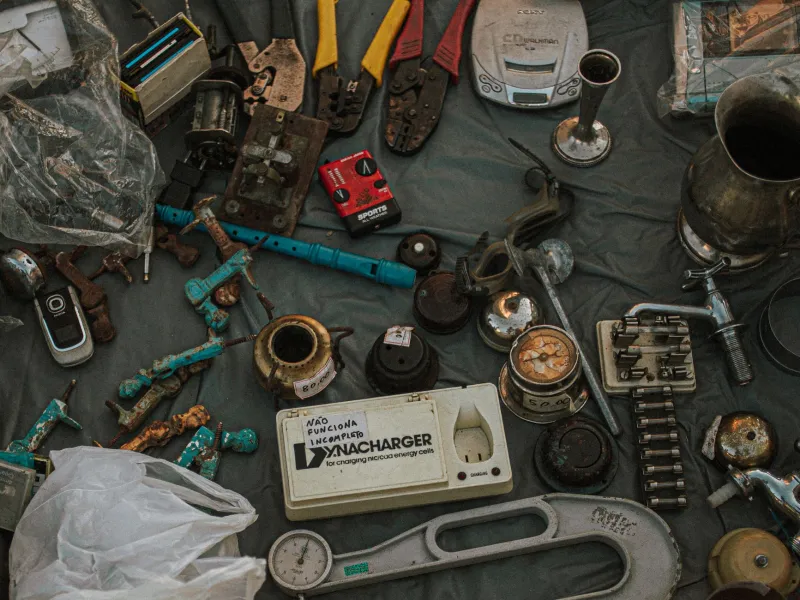
Here's the short list, compiled from my own sales and everyone I ambushed with questions: tools, working lamps, kids' stuff, anything with a plug that visibly functions, and vintage glassware your grandmother would recognize.
Here's the long list of things that mysteriously don't: exercise equipment, board games with missing pieces, self-help books, and — universally, inexplicably — decorative candles. I watched a woman drive a hard bargain on a rusted socket wrench set, then physically recoil from a brand-new Yankee Candle priced at one dollar.
One seller, a retired postal worker named Denny running a sale in his cul-de-sac, put it plainly: "People don't come here to need something. They come here to find something they didn't know they wanted. A wrench, they know they want. A candle, that's just a decision they don't want to make."
I have thought about Denny's theory a lot. It might be the most honest description of retail I've ever heard.
The Free Box Is the Real Main Event
Every serious sale has one: a box marked FREE, usually containing VHS tapes, old trophies, and cables for electronics that no longer exist. And here is the thing — the free box is never empty for long.
I gave away a rice cooker in ten minutes. The rice cooker I had priced at $3 sat there for six hours. When I finally moved it to the free box, a teenager took it, plus a fondue pot I hadn't even offered.
There's a lesson in this that extends well past driveways. Price creates friction. Free creates story — you didn't buy a rice cooker, you rescued one. The transaction is no longer about the object. It's about the narrative you get to keep.
Why Not Just Facebook Marketplace?
This is the question every skeptical relative asked me. And sure, the apps move more stuff. But Marketplace is commerce in its purest, coldest form: a listing, a price, a stranger who may or may not show up, the dreaded "is this still available?" ghosting.
A garage sale is commerce wrapped in an excuse to be outside. You meet your neighbors. You hear about who's downsizing, who's moving to Arizona, whose kid just got married. One woman bought my mother's old sewing machine and told me, unprompted, about teaching home ec in Toledo in 1974. No algorithm produces that.
The garage sale persists because it was never really about liquidating inventory. It's a neighborhood's nervous system, briefly made visible.
The Pricing Folklore
Garage sale pricing is not economics; it's folklore, passed down and regionally mutated. The consensus among my interviewees: nothing over $20 unless it's furniture, round down to the quarter, and never, ever price anything at $1.99 because "this ain't a Walmart, hon."
Early birds are another law of nature. I posted my sale for 8 a.m.; at 7:04 there were already headlights idling at the curb. These are professionals — resellers scanning for underpriced Pyrex and vintage tools — and honestly, God bless them. They bought the good stuff before the neighbors got out of bed, and they always paid in small bills without complaint.
What I Kept
I made $214 over three Saturdays. Not life-changing money. But I also unloaded a garage's worth of my late father's odds and ends to people who wanted them — actually wanted them — which is a form of settlement no app offers.
The last thing to go was a bread machine, ironically. A man in a visor paid me $5 for it and drove off before I could tell him about the other bread machine, the one I'd haggled over weeks earlier. Somewhere in this city, that machine is also changing hands for five dollars, and both of us are probably happier for it.
The garage sale economy doesn't run on money. It runs on the pleasant fiction that our stuff deserves a second act, and the quiet generosity of strangers willing to give it one — usually for less than five bucks, occasionally for free.