My Favorite Diner Has No Address
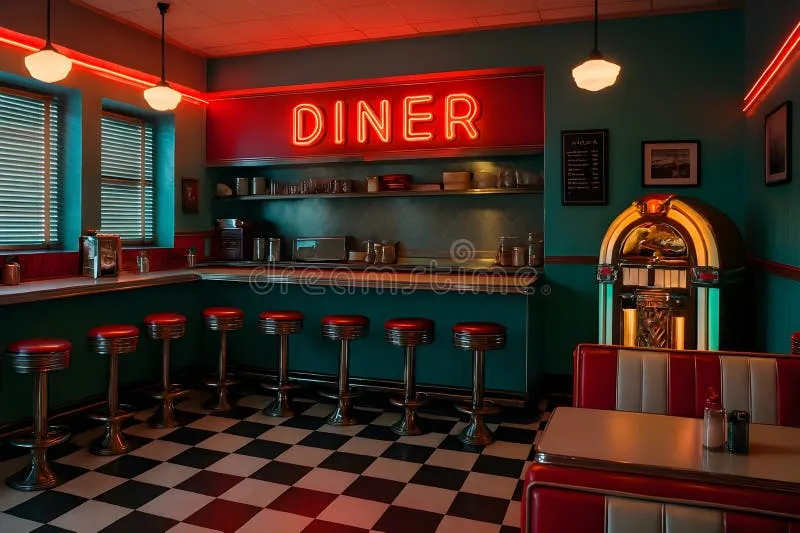
Photo: empty diner counter at night neon glow moody, via thumbs.dreamstime.com
There's a Discord server I've been in for six years. I could tell you what time the regulars usually drift in, who always posts the first meme of the morning, which username went quiet last spring and never came back. I could not tell you a single person's face, street address, or — in some cases — real name. And yet, if this place burned down, I'd feel it.
Sociologist Ray Oldenburg coined the term "third place" back in 1989: the spots that aren't home and aren't work, where people gather voluntarily and nobody's keeping score. The classic American examples are the diner counter, the barbershop, the tavern with the neon sign in the window. Places where the bartender knows your order and the booth by the window is yours, even though you never called dibs.
I don't have one of those anymore. I have a server with channels.
The Watering Hole Moved
Nobody decided this. It just happened, the way neighborhoods change. The corner bar where Norm pours the beer became a subreddit where I recognize usernames. The diner counter became a Twitch stream's chat, where the same hundred people show up every Friday night like it's trivia night at the VFW hall.
These places have their own architecture of familiarity. There's the guy who argues about college football in a channel about audio equipment. There's the person who posts their garden every June and everyone pretends they only came to the server for the gardening posts. There are inside jokes with actual lore — origin stories, disputed canon, a whole mythology nobody wrote down.
That's the thing about a regular spot: the regulars are the décor. Take away the people and you're just sitting in a room. The same is true online, maybe more so. A Discord server with nobody in it is a ghost town made of text. The place only exists when we show up.
What We Get
Here's what nobody warns you about: these digital haunts can be better than the physical ones in certain ways. Nobody checks what you look like. The introvert at the corner table is on equal footing with the loud guy at the bar. You can be a regular in your pajamas, at 1 a.m., while the baby sleeps on your chest.
For a lot of Americans — the night-shift nurse, the rural teenager forty minutes from the nearest town, the new dad who can't exactly linger over a beer anymore — these places aren't a consolation prize. They're the only third place they've got, and honestly? It works. The friendship is real even if the handshake never happened.
There's also a low-stakes consistency to it. Walking into the same channel every evening and seeing the same usernames is a small, quiet ritual. In a decade where everything feels like it's being rearranged — jobs, cities, the whole culture — that's not nothing. That's ballast.
What We Pay
But let's not pretend the ledger balances perfectly.
A physical third place roots you in a specific patch of ground. It forces you into community with people you didn't choose — the neighbor with the annoying laugh, the old-timer with opinions from 1974. Online, we self-sort. Every room is curated, every community is a filter bubble with a welcome mat. It's comfortable, and comfort is exactly the problem. The diner counter made you rub shoulders with the whole town. The subreddit only shows you your own tribe, holding up mirrors.
There's also the fragility. A bar can close; a Discord can vanish. One day the owner loses interest, the server gets archived, and the place where you spent a thousand evenings simply stops existing. No going-out-of-business sale, no last round. Just a link that doesn't load. I've watched two communities dissolve this way and it felt closer to a breakup than a change of address.
And then there's the body of it all. Text on a screen doesn't hand you a cup of coffee. Nobody notices you look tired. Some portion of what third places do — the accidental eye contact, the shared weather, the simple fact of occupying space together — doesn't survive the translation to digital.
Does It Count?
I keep coming back to that question. Does belonging to a place with no address count as belonging?
I think it does, with an asterisk. The human need being met is the same one the corner bar met: recognition without obligation, company without pressure. When a regular in my server had a health scare last year, forty strangers from eleven states chipped in on a meal train for his family. You can't tell me that's not a neighborhood doing neighborhood things.
But the asterisk matters. These places ask nothing of us geographically, which means they also anchor us to nothing. You can be a regular at a digital watering hole while your actual street sits empty of anyone who knows your name. The third place used to pull you out the front door. Mine pulls me deeper into the chair.
So I've started treating it like a relationship instead of a location. I show up regularly, but I don't confuse it with the whole of my life. The server is the diner. The walk around my actual block, the wave to the guy with the dog — that's the walk home.
Both count. Just don't mistake the tab you keep online for the one you keep in town. A person needs at least one place where somebody could describe them to a stranger — and at least one where nobody ever could.